Orange Economy 2026: 3D Animation Skills Surge
Orange Economy, 3D Animation, Creative Industries, Future Skills
The Orange Economy in 2026: Where 3D Animation Skills Are Booming
The global Orange Economy is entering a high-growth phase, and 3D animation for movies and immersive content is right at its center. Here is how policy, technology, and new skills are reshaping creative careers in 2026.
What the Orange Economy Looks Like in 2026
The Orange Economy, a term popularized by Iván Duque and Felipe Buitrago, covers sectors where creativity, culture, and intellectual property drive value: film, animation, gaming, design, music, fashion, publishing, and more. Far from being a niche, this “creative economy” is now recognized as a strategic growth engine worldwide, supporting innovation, soft power, and sustainable jobs (IMPRI India; Government of India Economic Survey 2025–26).
In 2026, three big forces are shaping this landscape: policy support, AI transformation, and the rise of the creator economy. Together, they are creating unprecedented demand for skilled 3D artists, especially in animation for movies, streaming series, and immersive experiences.
Policy Momentum: India and Nigeria as Case Studies
India has moved the Orange Economy from the sidelines into the core of its development strategy. The 2025–26 Economic Survey formally recognizes creative industries as a policy priority, and the 2026–27 Union Budget backs this with funding for institutions, infrastructure, and training (IMPRI; PIB 2026). A standout initiative is the creation of AVGC (Animation, Visual Effects, Gaming, and Comics) Content Creator Labs in 15,000 secondary schools and 500 colleges. With the AVGC sector projected to need nearly 2 million professionals by 2030, this is a clear signal that animation and related skills are seen as mainstream employment, not side hobbies.
In Africa, Nigeria is emerging as a creative powerhouse. Its film, music, fashion, gaming, and digital arts industries contribute an estimated $4.2 billion annually to GDP, with platforms like Orangeeconomy.ng helping creators access funding, mentorship, and global markets. The National Summit and Exhibition on the Orange Economy in Lagos (October 6–8, 2026) is designed to connect policymakers, investors, and studios to scale this growth even further.
📌 Key Takeaway: Governments are no longer treating creative work as “nice to have.” They are building long-term ecosystems—schools, labs, funding, and regulation—around animation, gaming, and digital storytelling.
AI, Creators, and the New Business of Storytelling
Technology is accelerating this shift. Across the global creator economy, AI has become part of everyday workflows. In a 2026 report by Epidemic Sound, 94% of surveyed creators already use AI, and 72% expect to increase their use within a year. Yet most agree that human creativity remains the differentiator and that protecting intellectual property and creative control is crucial.
Economically, the stakes are high. The U.S. creator economy alone is projected to surpass $40 billion in 2026, nearly double 2025, while the global market is expected to exceed $230 billion. Creators—many of them animators, motion designers, and storytellers—are building sustainable businesses, diversifying income streams, and focusing on owning their audiences rather than relying solely on big platforms.
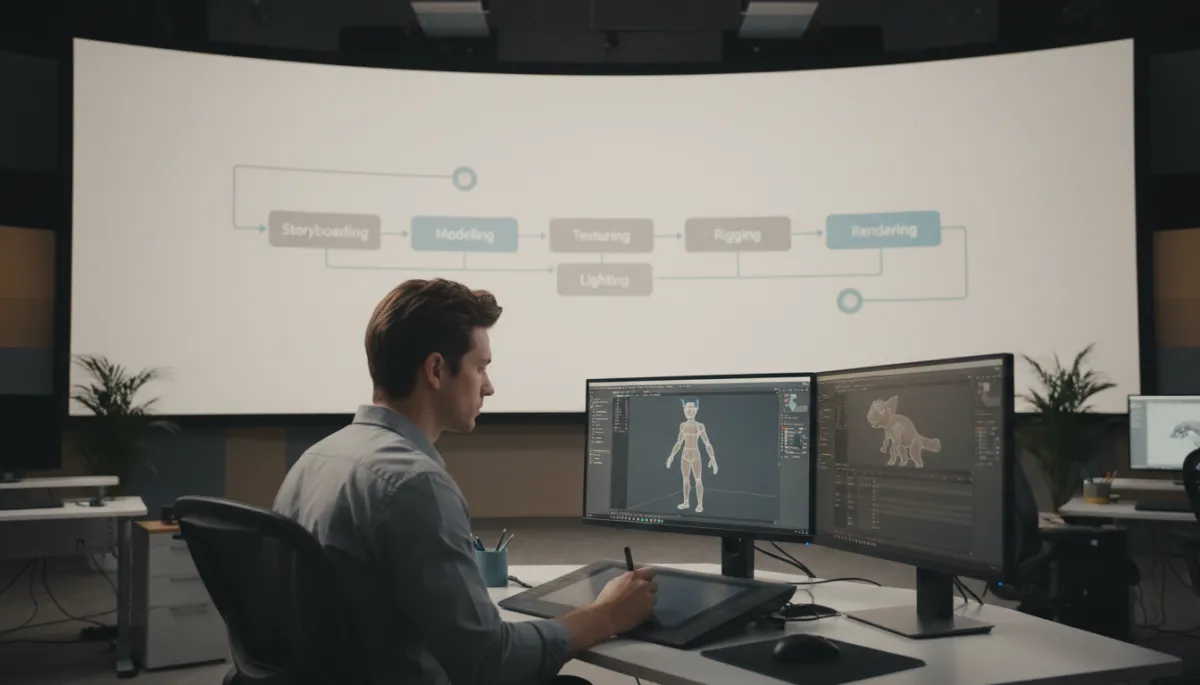
Modern 3D pipelines blend storytelling, real-time tools, and AI assistance from concept to final frame.
3D Animation Skills in High Demand for Movies and Immersive Content
Within this thriving Orange Economy, 3D animation is evolving rapidly. Studios, streaming platforms, and virtual production houses are searching for artists who combine strong fundamentals with future-facing technical skills. Here are the capabilities now trending and in highest demand for 3D animation movies and cinematic experiences.
1. Real-Time Rendering and Virtual Production
Proficiency in real-time engines such as Unreal Engine and Unity has shifted from “nice bonus” to “top requirement.” Real-time 3D skills now command significantly higher salaries—Georgia industry data suggests around 57% above average and 18% higher than general 3D graphics roles. For animated films, real-time tools are used for:
Previsualization and layout of complex scenes and camera moves
Virtual production and in-camera visual effects on LED stages
Interactive look development and lighting, reducing render times and costs
2. VR, AR, and Immersive Storytelling
As studios experiment with VR shorts, AR experiences, and mixed-reality tie-ins for films, animators who understand immersive design are in high demand. Skills include:
Building comfortable, readable scenes in 360° environments
Designing interactions and camera movement that avoid motion sickness
Optimizing assets for headsets and mobile AR while preserving visual quality
3. Procedural Animation, Simulation, and Effects
Big animated features and series often involve crowds, environments, and physics-heavy scenes that are impossible to hand-animate frame by frame. That is where procedural animation and simulation come in. Skills in tools like Houdini, alongside Maya or Blender, allow artists to:
Generate believable crowds, foliage, weather, and destruction systems
Automate secondary motion such as cloth, hair, and props
Iterate quickly on complex effects shots while keeping them art-directable
4. Motion Capture and Hyper-Realistic Performance
For films that aim at hyper-realistic or stylized-real performances, motion capture (MoCap) has become standard. Studios look for animators who can:
Work with MoCap data, cleaning and refining it for believable motion
Blend captured movement with keyframed animation for stylization
Collaborate closely with actors, directors, and virtual production teams
5. AI-Enhanced Workflows and New Hybrid Roles
AI is no longer a novelty; it is built into major tools. At SIGGRAPH 2026, Autodesk announced AI-driven features in Maya and 3ds Max, including MotionMaker for animation data, 3D Gaussian splats, and real-time Arnold viewport rendering. Job listings mentioning AI have risen sharply over the last three years, and new roles—such as AI look-dev artists, dataset curators, and “prompt-and-finish” specialists—are emerging in studios.
For 3D animators, this means learning to:
Use AI tools for blocking, in-betweening, facial animation, and cleanup
Maintain creative control and ensure results match the director’s vision
Understand IP and data ethics when using AI-generated elements
6. Character Rigging, Skinning, and Expressive Performance
No matter how advanced the tools become, rigging and skinning remain critical for film-quality animation. Studios need specialists who can build rigs that are:
Stable and efficient for production-scale projects
Capable of subtle, emotion-rich facial expressions and nuanced body language
Flexible enough to support both stylized and realistic animation styles
7. Storytelling, Hybrid Aesthetics, and Collaboration
Across all these technical trends, one constant remains: story is king. Studios and streaming platforms are looking for animators who understand pacing, character arcs, and emotional beats. Hybrid aesthetics—mixing 3D with 2D linework, painterly textures, or cel shading—are also in vogue, demanding a mix of traditional art skills and digital fluency.
Just as important is the ability to collaborate across disciplines: animators now work closely with game designers, technical directors, programmers, sound designers, and marketing teams to build cross-platform story worlds that live as films, games, AR filters, and social content simultaneously.
💡 Pro Tip: Balance your reel. Show strong character acting and storytelling, then demonstrate you can handle real-time, MoCap, or simulation-heavy shots too.
Positioning Yourself for the Future of the Orange Economy
For students and professionals, the message from 2026 is clear: the Orange Economy is growing fast, and 3D animation is one of its most dynamic engines. Countries like India and Nigeria are investing heavily in talent and infrastructure, while global studios race to hire artists who can navigate AI, real-time tools, and immersive formats without losing sight of story and craft.
To thrive, focus on three pillars:
Fundamentals: classical animation principles, drawing, storytelling, cinematography, and acting for animators
Tools and Tech: Maya or Blender, Unreal Engine, MoCap, procedural workflows, and AI-assisted tools
Mindset: continuous learning, cross-disciplinary collaboration, and a business-savvy approach to building your own creative brand
📌 Key Takeaway: To understand exactly which skills you need to work and grow in the Orange Economy, book your free counselling session at ZICA Hegdenagar and get personalised guidance on your next steps.
In an era where the Orange Economy is finally being treated as core infrastructure, 3D animators are not just technicians—they are entrepreneurs, storytellers, and cultural ambassadors. The skills you build today can power not only the next blockbuster animated movie, but also the broader creative economies of tomorrow.